The Middle East, Cold War, and Emerging Technologies: The Contributions of Henry Kissinger
Event date
From Lessons History.
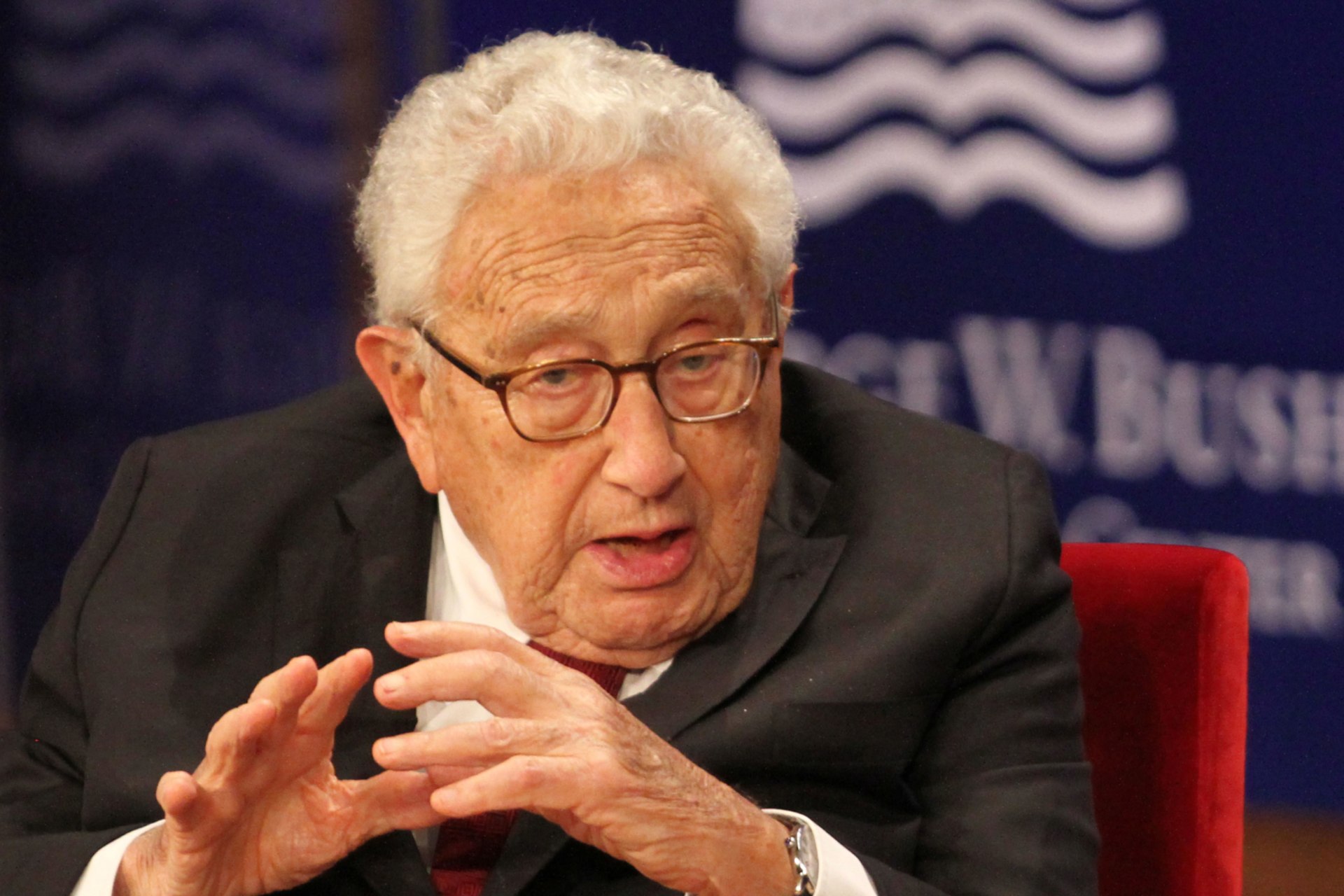
This symposium explores the trajectory of three critical foreign policy domains that Henry Kissinger, a longtime member of the Council on Foreign Relations, engaged with throughout his career in and out of government, and the lessons learned for U.S. foreign policy today.
Virtual Session I: Conflict in the Middle East
Transcript
FROMAN: Good morning, everybody. Thank you for joining us. And we’ve got, in addition to the folks here, I think about a hundred people or so on Zoom. So thank you to our virtual audience as well. My name is Mike Froman. I’m president of the Council on Foreign Relations.
And it’s really a distinct honor to open up today’s symposium honoring Henry Kissinger. Everybody, of course, is deeply familiar with Kissinger’s career—former national security adviser, former secretary of state, sometimes both at the same time. Nobel laureate as well. Foremost practitioner-scholar in the field or, as Madeline Albright called him, a demigod. I think Kissinger’s only objection to that was the use of the word “demi” at the beginning. (Laughter.) Significant impact on opening to China, détente with Russia, SALT I and nonproliferation, shuttle diplomacy in the Middle East.
But more importantly for today’s purposes, he was born just two years after the foundation of the Council on Foreign Relations. He’s had a complicated seven-decade relationship with the Council, that left both very much better off. It was in 1955 that he was walking through Harvard Yard and Arthur Schlessinger pulled him aside and suggested he go down to...
Virtual Session II: Cold War Diplomacy—The Soviet Union, China, and Vietnam
Transcript
NAFTALI: Good morning. It’s a pleasure to be here today.
We have an excellent panel. You will see their bios in the materials you were given so I will not be mentioning again their great accomplishments, although I want to underline the fact that Carolyn’s prize-winning book is called Fire and Rain. In the biography you will see it has an old title that was not as good as the current title which is the prize-winning title.
I’ve asked each of the panelists to start with a few minutes of reflections on some of the key themes that they would like to develop over the course of our conversation and I will begin with Ambassador Lord.
LORD: Thank you, Tim.
I think the best way to survey the Kissinger-Nixon years is for everybody to read my book—(laughter)—Kissinger on Kissinger. K.T. McFarland, who became deputy national security adviser under Trump, and I interviewed Henry, and we drilled down in depth precisely on the three issues we’re focusing on today—China, Soviet Union, and Vietnam—as well as the Middle East, which you heard about in the previous panel.
So if everybody buys the book you will double my sales, I think—everybody in this...
Virtual Session III: Emerging Technologies—From the Nuclear Age to AI
Transcript
ROHLFING: OK, good morning all. Welcome to today’s Council on Foreign Relations Symposium, “The Middle East, Cold War, and Emerging Technologies: The Contributions of Henry Kissinger.” This session is titled “Emerging Technologies—From the Nuclear Age to AI.” I’m Joan Rohlfing, president and chief operating officer of the Nuclear Threat Initiative, and I will be presiding today over today’s discussion.
So let me introduce the speakers. First of all, with me here, Samm Sacks, senior fellow of the Paul Tsai China Center at Yale Law School, and senior fellow, future security at New America. Also, on Zoom, we have Dr. Graham Allison, the Douglas Dillon Professor of Government at the Harvard Kennedy School; he is also a CFR member. And Niall—Dr. Niall Ferguson, Milbank family senior fellow at the Hoover Institution at Stanford University, and the author of Kissinger: The Idealist, covering the years 1923 to 1968.
It’s wonderful to see both of you, if virtually. So I want to start this morning by talking a little bit about Dr. Kissinger and his work in the emerging technologies space. In his lifetime, Dr. Kissinger experienced several technological revolutions, two of which—nuclear and AI—posed potentially existential risks to humanity. His life’s work...